
In the open, $200–$500
A visible, reachable burst, garden, garage, accessible wall, cut out and repaired at business-hours rates.
Water finds the ceiling fast and the cause slowly, the wet patch is almost never over the split. We shut it down, trace the failure to its source, and repair the pipe rather than bandaging the symptom. Around the clock across Box Hill and the Hills District.
Most of what bursts around Box Hill is age meeting pressure. Original copper lines from the mid-century build era wear thin from the inside until a pinhole opens; older galvanised steel rusts until a fitting lets go; and garden poly lines split where a root or a shovel found them years ago. Add mains pressure that runs high across parts of the Hills District, and the weakest point eventually announces itself.
The catch is that water travels. It runs along the outside of the pipe, along joists and wall plates, and surfaces somewhere downhill of the actual split, which is why the wet patch on the ceiling is so often metres from the leak. Repairing where the water shows up fixes nothing. We trace the line back to the failure itself, repair that, and pressure-test before closing anything back up.


Box Hill’s new estates are still settling in, and sand, mortar and building rubble washed into fresh pipework is a leading cause of early blockages here.
It is not the pipe that fails in a recent build, modern pex and copper are fine. It is the connections: a crimp not fully closed, a fitting cross-threaded, a flexible hose torqued too hard behind a vanity.
Those failures show up in the first few years and then largely stop. If yours is a newer home, the odds strongly favour one bad connection rather than anything systemic.
On Box Hill’s remaining acreage and rural-fringe blocks, long private drains and septic systems need cameras and the right access to clear and inspect properly.
Sloping properties are full of retaining structures, and services frequently run behind or beneath them because that was the only route available. A leak in that position is both harder to reach and more consequential, saturated backfill is what makes retaining walls fail.
If water is showing at the base of a wall, treat it as urgent even if the volume looks trivial. The plumbing repair is minor next to what the wall costs.
The braided hoses under sinks and behind toilets are the single most common source of catastrophic water damage in newer homes. They have a service life of around ten years and they fail without warning, at full mains pressure, whether anyone is home or not.
Rapid subdivision means some PVC lines were laid in a hurry, sagging, dips and bad falls trap waste and cause repeat blockages in newer homes.
They cost very little to replace and it is the highest-value preventive plumbing you can do. If yours are original and the house is approaching a decade, change them before one changes itself.
Freshly graded estates around The Gables shed a lot of runoff, and heavy Hills rain quickly overwhelms new stormwater pits that silt up and back up.
Mains pressure varies with elevation, and properties low on a slope frequently sit at the high end of the range. Higher standing pressure shortens the life of every fitting in the house, particularly flexible hoses under sinks and behind toilets.
If you are at the bottom of a hill and you have had more than one fitting let go, a pressure test is worth doing. A pressure-limiting valve is a small part that prevents an expensive category of failure.
Within the statutory defects period, workmanship failures are generally the builder's responsibility, and a fitting that was never properly made up is workmanship.
Box Hill sits on Sydney’s north-western growth fringe in the Hills District (postcode 2765), a fast-changing suburb where former farmland is becoming master-planned estates like The Gables and Box Hill North. Bordering Rouse Hill, Nelson and Annangrove, its drains range from brand-new PVC lines to long private runs on the rural blocks, and we know the local ground well.
What decides it is evidence of the failure mode, gathered before the repair. We photograph the failed connection in place and describe it in terms an insurer or builder can act on. Have it fixed tonight by all means; the documentation is what recovers the cost.
A visible, reachable burst, garden, garage, accessible wall, cut out and repaired at business-hours rates.
Adds the tracing and the careful access: finding the true split before opening anything, so only one hole gets made.
Detection gear, concrete access or a reroute. Precision here is the whole cost battle, small hole, right place.
Roughly $180–$250/hr against $120–$160 daytime, plus call-out. With the meter off, morning is sometimes the smarter spend, we will tell you honestly.
Leak detection's first hour, locating the failure before demolition, reliably cheaper than exploratory holes.
Every repair leaves pressure-tested and carries a lifetime workmanship warranty. Figures here are indicative of the 2026 Sydney market rather than a quote from us, you get your own number as a fixed price before any work starts.
Meter valve clockwise: we walk you through it on the phone, and the flood stops before the van starts. On site we isolate just the injured line when the layout allows it.
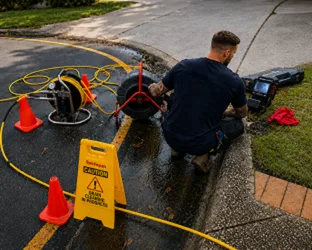
Acoustic listening, thermal imaging and section-by-section pressure testing find the actual split, which is rarely under the wet patch.

The damaged section is removed and replaced properly. If what we expose says the whole run is finished, you hear it straight, with prices for both roads.
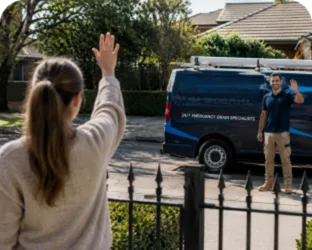
Mains-pressure test before anything closes. The repair demonstrates itself; then, and only then, do surfaces go back.
Shut the meter valve, then call. We will talk you through making it safe while a crew heads your way.
One fixed price, one properly repaired pipe, one pressure test you watch pass. That is the whole offer.

Leave your details and our local Box Hill team will call you back fast.